

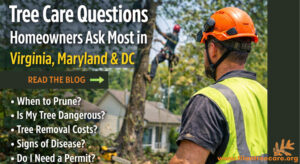
Tree Care Questions Homeowners Ask Most
If you’re a homeowner in the Mid-Atlantic, your trees face everything from coastal storms and heavy snow to summer drought and dense urban soil conditions. Customers regularly ask us the same important questions about safety, timing, cost, and tree health. Below is a guide that answers the most common tree care questions for property owners in Virginia, Maryland, and Washington DC based on what our crews see every week at Titan Tree Care.
Q – When Is the Best Time of Year to Trim Trees in the DMV Area?
A – For most tree species in Virginia, Maryland, and DC, late fall through early spring is ideal for structural pruning because:
- Trees are dormant
- Leaf drop improves visibility
- Disease and insect spread risk is lower
- Cuts heal more efficiently in spring
However, hazardous limbs and storm-damaged branches should be removed immediately, regardless of season.
Exception: Flowering ornamentals should often be pruned right after they bloom.
Q – How Do I Know If a Tree Needs to Be Removed?
A – A tree may need removal if you notice:
- Large dead branches in the canopy
- Deep trunk cracks or splitting
- Mushrooms or fungal growth at the base
- Sudden leaning after storms
- Hollow trunk sections
- Major root damage from construction
- More than 50% canopy dieback
In the Mid-Atlantic, saturated soils and storm winds frequently weaken root systems, especially in older suburban neighborhoods. A certified arborist inspection is the safest way to determine risk.
Q – What Are Signs My Tree Is Diseased?
A – Common regional warning signs include:
- Wilting or spotted leaves in spring/summer
- Early leaf drop
- Oozing bark or dark streaks
- Peeling bark patches
- Dead branch tips
- Insect holes or sawdust at the base
Maryland and Virginia properties commonly experience fungal leaf diseases, root rot, and borer infestations due to humidity and temperature swings. Early diagnosis can often save the tree.
Q – Should Mature Trees Be Watered During Summer?
A – Yes, especially during heat waves and drought periods. Even large established trees benefit from deep, infrequent watering when rainfall is limited.
Best practice:
- Slow soak at root zone
- 1–2 times per week during drought
- Morning watering preferred
- Avoid shallow daily watering
Urban and suburban trees suffer more drought stress due to compacted soils and limited root zones.
Q – Is Tree Topping a Good Idea?
A – No, topping is harmful and outdated.
Tree topping:
- Creates weak regrowth
- Increases decay risk
- Shortens tree lifespan
- Makes trees more dangerous long-term
Proper structural pruning reduces size and weight without damaging tree biology.
Q – How Much Does Tree Removal Cost in Virginia, Maryland & DC?
A – Tree removal pricing depends on:
- Tree height and diameter
- Location near structures
- Access for equipment
- Need for crane removal
- Hazard level
- Cleanup scope
- Permit requirements
Urban removals typically cost more due to restricted access and rigging complexity. A site visit is usually required for accurate estimates.
Q – What Should I Do After Storm Damage?
A – After major storms:
- Stay clear of hanging or cracked limbs
- Do not attempt DIY cutting near tensioned branches
- Watch for partially uprooted trees
- Photograph damage for insurance
- Schedule a professional hazard assessment
Storm-damaged trees can fail days or weeks later, not just immediately.
Q – Why Hire a Certified Arborist Instead of a Landscaper?
A – Tree work is technical and high-risk.
Certified arborists are trained in:
- Tree biology
- Structural pruning standards
- Hazard assessment
- Rigging safety
- Disease diagnosis
- Root protection
Improper cuts or removals can permanently damage trees or create liability risks.
Trees add beauty, shade, and property value across Virginia, Maryland, and Washington DC but they require region-specific care. Regular inspections, correct pruning, and early problem detection make the biggest difference in long-term tree health and safety.
Get a Quote
Looking for expert tree care? Fill out the form below and we’ll be in touch!